Musicathon Runner-Up Interview: Inside Lyri, the Songwriting App That Keeps the Artist in Charge
Lyri helps songwriters keep going when an idea stalls. Its creator, Tiwa Bakre, explains how the app builds on your own lyrics instead of generating generic ones, and why isolating a single layer of a beat with LALAL.AI can spark a melody you’d miss in the full mix.

Earlier this year, LALAL.AI teamed up with Musixmatch and several other partners to host the Musicathon, a music tech hackathon that drew developers and musicians from around the world. Participants had a brief to build something with the sponsors’ APIs that shows where music technology could go next.
Taking second place was Lyri, a songwriting workspace made for the moment a song stalls halfway through. We spoke with its creator, Tiwa Bakre, about how Lyri works under the hood and why, unlike the many tools that churn out generic AI lyrics, it leaves the actual writing to the artist. Tiwa also told us where the app is heading next.
“I reverse-engineered my own process and turned parts of it into Lyri”
My background is mainly in game and virtual reality development. I’m currently building my game and software development studio, Shroozy. Outside of that, I make music and write my own songs, so Lyri came from my own experience as a songwriter.
A songwriting tool is something I had been thinking about for a while. When ChatGPT became more mainstream in 2023, I did try using it here and there to help with lyrics, but it never really felt right. A lot of the suggestions sounded generic; they might rhyme, but they didn’t really fit the song I was writing.
That’s where the idea for Lyri came from.
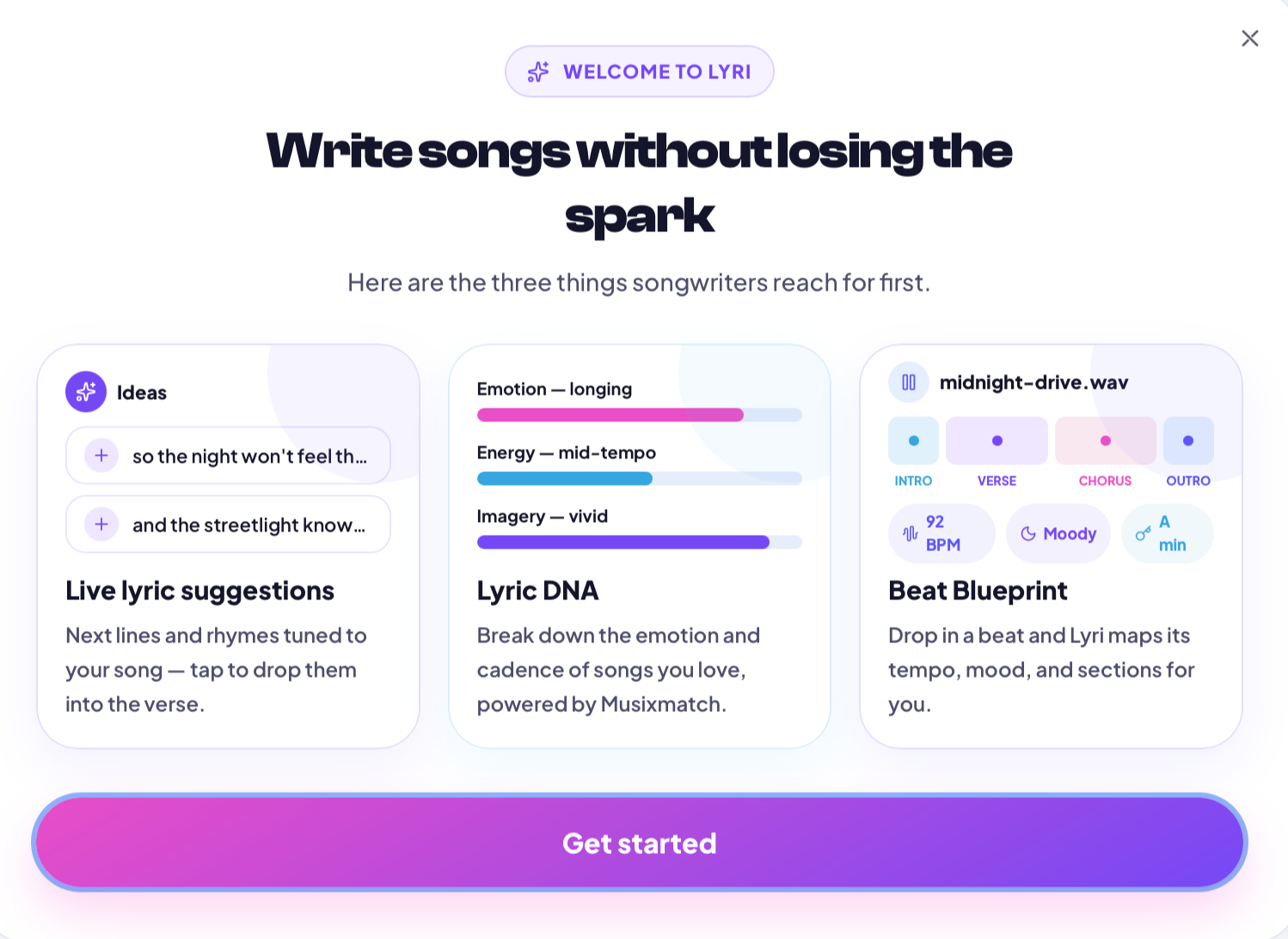
I wanted something that could look at the lyrics I had already written, understand what the song was about, look at songs in a similar space, and then give me an idea for what could come next.
“It’s still only there to help. You need your own song idea, your own direction, and at least a few lines to work from. Lyri isn’t meant to take over the creative side. It’s meant to help you get unstuck.”
Before Lyri, I was working on another app called BDRM. The idea was for it to be a one-stop place for artists. It had tools for improving cover art, turning artwork into videos for platforms, splitting stems, and getting marketing advice.
I did eventually pull back from that idea, but working on it taught me a lot. I had already played around with LALAL.AI for stem splitting, and I had already spent time thinking about the kinds of tools independent artists might actually use.
When the Musixmatch Musicathon was announced, I spent a while thinking about how I could use Musixmatch in a way that actually solved a real problem.
That’s when I started looking at the way I write songs myself. I basically reverse-engineered my own process and turned parts of it into Lyri. The part I normally struggle with is the second verse. I can have the first verse and the hook done, then I get to the second verse and start going back and forth over what should come next. Sometimes, it isn’t even necessary but other times a second verse definitely gives some life to an already great song.
That happened with Lightweight, the song I tested Lyri on. I had started the second verse and made some good progress, but then I got stuck and ended up in that weird limbo where nothing felt right.
That’s where Lyri helped.
It already had the first verse, the hook, the mood, and the theme of the song, so it had a lot more to work with than a normal blank prompt. It gave me some really useful suggestions and showed me songs that were in a similar space. It brought up songs like Drunk by Ed Sheeran and Kilby Girl by The Backseat Lovers.
I still made the final decisions, but Lyri helped me get past the block and finish the song.
Lyri under the Hood: “The biggest trade-off was stopping myself from turning Lyri into a DAW”
I worked on the Musixmatch integration, the audio and stem tools, the writing experience, and the overall product, all on my own. The biggest trade-off was stopping myself from turning Lyri into a full-blown DAW. Lyri already lets users upload a beat, write while listening to it, split the beat into stems, and sing or rap their lyrics into the app.
At one point, I thought, why not let people record full vocal takes over the beat as well?
But once I started thinking about it properly, it became too much. I’d need to handle different vocal takes, recording controls, the lyrics, the beat, the stem controls, and everything else on the same screen.
It was getting messy and way too complicated for the hackathon deadline, so I scrapped that idea.
“Lyri is meant to be a songwriting app with a few extra tools around it. It doesn’t need to become a full recording studio.”
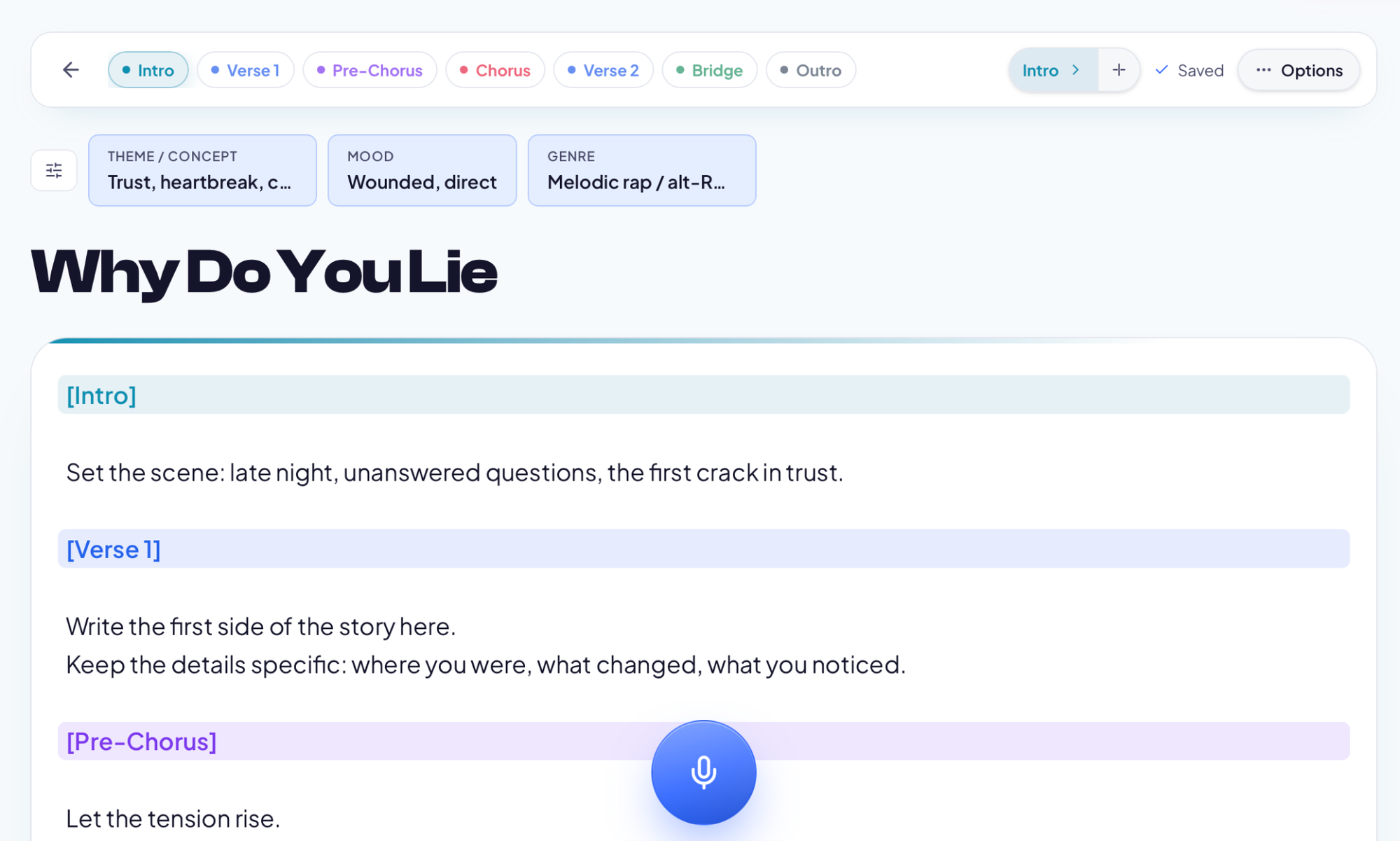
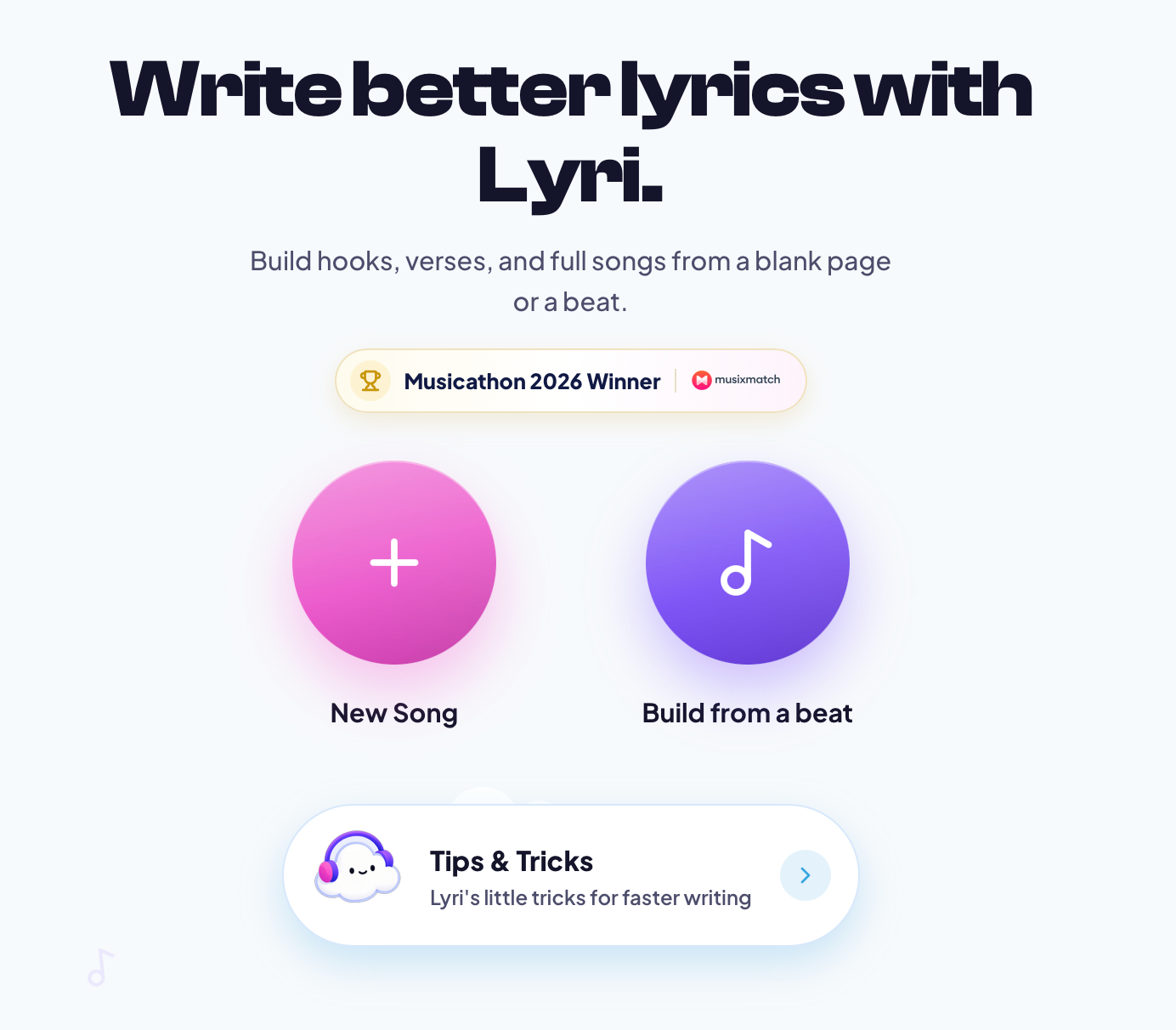
When opening Lyri, you can either start with a beat or click New Song and start on a blank page to write your ideas down. You can type your first lines, or you can tap the microphone and sing or rap whatever is in your head.
Lyri takes that recording, turns it into text, and arranges it line by line. From there, you can hover over the last line you wrote, or go back to an older line, and ask Lyri what could come next.
Lyri can suggest another line, show words that rhyme, and show songs that feel close to what you’re making. You can use the suggestion, change it, ignore it, or just take inspiration from it. Then you just keep going until that rough idea starts turning into a proper verse.
“The main thing is that Lyri doesn’t try to write the whole song for you. It helps you carry on with the idea you already had.”
Lyric DNA is a feature that uses your lyrics to find songs that feel close to what you’re working on. It doesn’t only look at the words; it also looks at the context of the lyrics and what the song seems to be about.
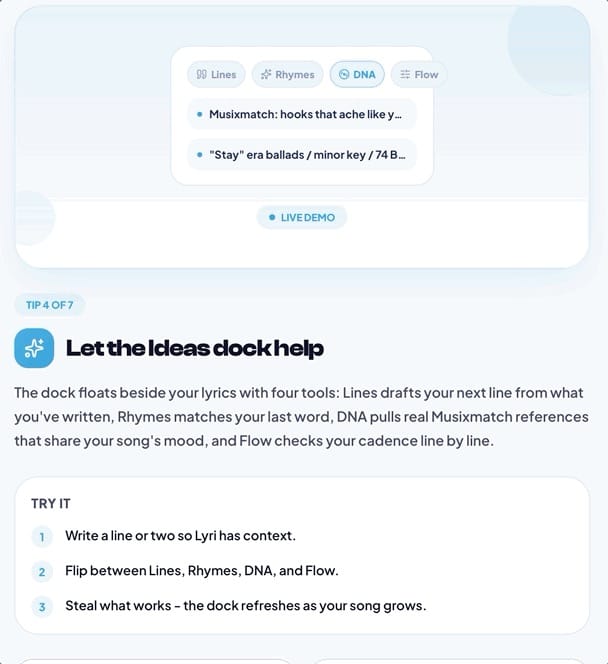
It’s not a permanent artist profile and it’s not just based on genre. It changes depending on the song you’re writing at that moment.
Beat Blueprint looks at the tempo, key, and energy of the beat. It also uses Cyanite’s music tagging and similarity search algorithms to get a better feel for the mood and genre. If you haven’t already added a theme, mood, or genre, Lyri can use the beat analysis to help fill some of that in.
I also use an audio model to add extra context where needed, especially if something is missing or unclear from the first analysis. The point is not just to show someone the BPM or key. It gives Lyri a better idea of what the beat feels like, so the lyric suggestions can match the song more closely.
Lyri’s sung-lyric capture is powered by ElevenLabs’ Scribe v2 speech-to-text model. You can sing or rap into the microphone, and Lyri turns that into written lyrics inside the song. It then arranges the words line by line, so you can edit them or ask for a suggestion from a certain point. I’ve tested it myself and I’ve been really impressed with it: it handles singing, rapping, rhythm, and multiple languages really well.
Each API handles a different part of Lyri.
🟡 Musixmatch helps with the lyric side of the product. It supports the related-song features, Lyric DNA, rhyme ideas, and the wider context used when Lyri is helping someone write.
🟡 ElevenLabs powers the singing and rapping-to-text feature, so users can get an idea out by using their voice instead of typing everything.
🟡 LALAL.AI handles stem splitting. It lets users break a beat into separate layers and listen to individual parts of the track.
🟡 Cyanite powers the Beat Blueprint. It analyzes the beat and gives Lyri things like the tempo, energy, mood, and genre.
Lyri is what brings all of those pieces together into one writing experience. The APIs each do their own specialist job, then Lyri decides how that information is used and shown to the user.
Where LALAL.AI Fits In: A Different Way to Listen
LALAL.AI is optional in Lyri. You would probably use it when you’re stuck and want to hear the beat in a different way. That’s something I do myself when I’m writing.
Sometimes, there’s one sound in the beat that your mind keeps going back to. It might be a guitar, a piano, a violin, or even just the drums, so splitting the stems lets you listen to that one layer by itself.
That can help you hear a new melody, find a different flow, or come up with a lyric that you might not have thought of while listening to the full beat. It’s just another way to play around with ideas when your brain gets stuck as it gives the songwriter a different way to look at the same beat.
Maybe you remove the drums and see how the track feels without them, or remove the piano and notice another sound that was sitting underneath it?
If you’re rapping, that can help you find new pockets in the beat. If you’re singing, you might hear a melody that you want your vocals to follow. The upload is mainly there for beats, so the stem tool isn’t really about fixing a finished song. It’s about helping the writer hear the instrumental from another angle.
There’s No Generic-AI-Lyrics Problem to Solve
Lyri looks at songs in a similar space to the song you’re writing. It also looks at the lyrics you’ve already written and uses all of that as context, and the Musixmatch integration plays a big part in that.
Lyri then combines that with the user’s own lyrics, the line they’re working from, and any theme, mood, or genre they’ve added. The final suggestions and the way everything is shown inside the writing experience come from Lyri’s own logic on top of those inputs.
On top of that, you can add extra details about the theme, mood, and genre of the song, so Lyri is not just being asked, “Give me a line that rhymes with this.”
It has the lyrics, the meaning behind them, the feel of the song, and references from music that sits in a similar space. That’s what stops it from feeling like a random AI lyric generator.
Two users aren’t going to have the exact same lyrics, mood, theme, genre, and song references, so the suggestions shouldn’t come out the same either. Lyri is there to help the artist keep their own voice. It gives them ideas, but the artist still decides what belongs in the song.
The Road Ahead
I definitely plan to keep on building Lyri! The app is now out on both the App Store and Google Play, and I’m still updating and improving the web version.
The first thing would be faster processing. That would be really useful, especially for longer tracks. I’d also like a better way for the system to detect which instruments are actually in the song before it starts splitting them. It’d be great if it could first detect what is present, then only show the user the stem options that make sense.
I’d also love to play around more with LALAL.AI’s voice-changing tools. What I’d really like is a way to use them in real time, instead of always having to send through a recording and wait for it to come back.
I’m also thinking about bringing back parts of the larger artist toolkit I was working on before. Instead of making Lyri one small part of that toolkit, I could build a wider set of artist tools around Lyri.
For now, I just want to get it released, keep improving it, and see how artists actually use it!
Follow LALAL.AI on Instagram, Facebook, Twitter, TikTok, Reddit, LinkedIn, and YouTube to keep up with all our updates and special offers.