Introducing Lynx: Our New Voice Isolation Neural Network
Lynx, LALAL.AI’s new voice isolation neural network, is live. Trained on a year of hand-cleaned data, it’s smaller and more consistent than earlier models.

Lynx, our newest neural network, is now live across LALAL.AI. It’s the result of a whole year of work, built to separate the human voice from just about everything else.
How We Built It
Rather than scraping a bigger dataset and running it through a pipeline, we spent months manually cleaning Lynx’s training data ourselves: listening through tracks one by one, filtering them, and trimming them down by hand. That process, combined with the architecture work that followed, stretched the project to a year from start to release.
We consider the resulting training set one of the cleanest we’ve used. It totals several hundred hours of carefully filtered audio, supplemented by several thousand additional hours of more loosely cleaned content used during pretraining. That data spans far more than clean studio speech. It includes whispering, labored breathing, sniffling, children crying and laughing, crowd noise, exotic bird calls, and everyday ambient sound.
We took on that manual effort because we haven’t found an automated method that can reliably clean speech through background noise this varied.
Architecture and Performance
Lynx runs on a proprietary architecture of the same name, built on a U-Net design with custom blocks and a non-local attention mechanism. It was optimized for embedded use cases, which is part of why it ended up so compact: roughly six times smaller than Andromeda, our previous flagship model.
The improvements are mostly qualitative. Lynx separates voice from more types of noise, and does so more consistently than our earlier models.
What It Filters Out
Lynx was made to strip away many kinds of noise, including birdsong, door creaks, footsteps, and engine noise. It’s easier to describe what Lynx leaves untouched (the voice itself) than to list every category of noise it can handle. In practice, that means you don’t need to know what’s cluttering your audio ahead of time. Lynx treats it as noise either way.
Upcoming Improvements
Lynx is still a statistical model, so occasional missteps happen. They are less frequent than with previous generations, and recurring issues can be addressed through further fine-tuning as we identify them.
We’re already working on two areas of improvement for the next update: separating choral and group vocals more cleanly, and improving speech extraction when a speaker is positioned far from the microphone. A follow-up update targeting both is already in progress.
How to Access Lynx
Lynx runs in the cloud, so there’s no need for a local GPU. Processing happens on our servers. It’s available through the browser, the mobile app, the desktop app’s Cloud mode, and via API for developers building it into their own tools.
It supports the same file formats already used across our platform:
Audio: MP3, OGG, WAV, FLAC, AIFF, AAC, M4A
Video: AVI, MP4, MKV, MOV, M4V
Lynx appears as a new option in our existing neural network picker, available in the Vocal Remover, Stem Splitter, and Voice Cleaner tools. In Vocal Remover and Stem Splitter, it powers the Voice and Noise stem. It’s now the default model across all three, so there’s nothing extra to select if you want to use it.
If you’d like to compare results or use the earlier model (Orion), you can still choose it from the picker. Here’s how to do it:
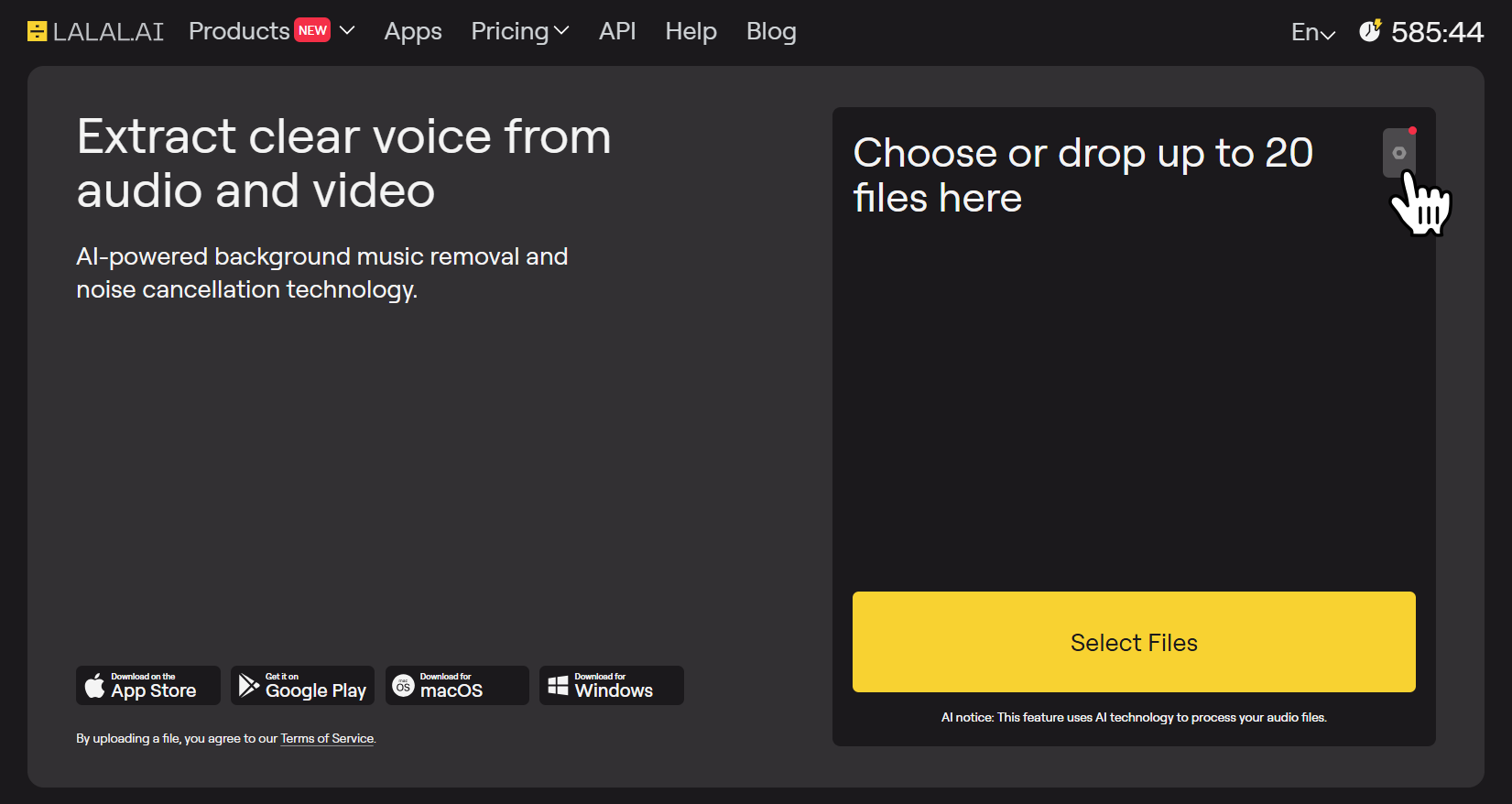
1. In the upload widget, click the settings icon at the top right corner.
2. In the appeared settings window, change the Neural Network selection from Lynx to Orion.
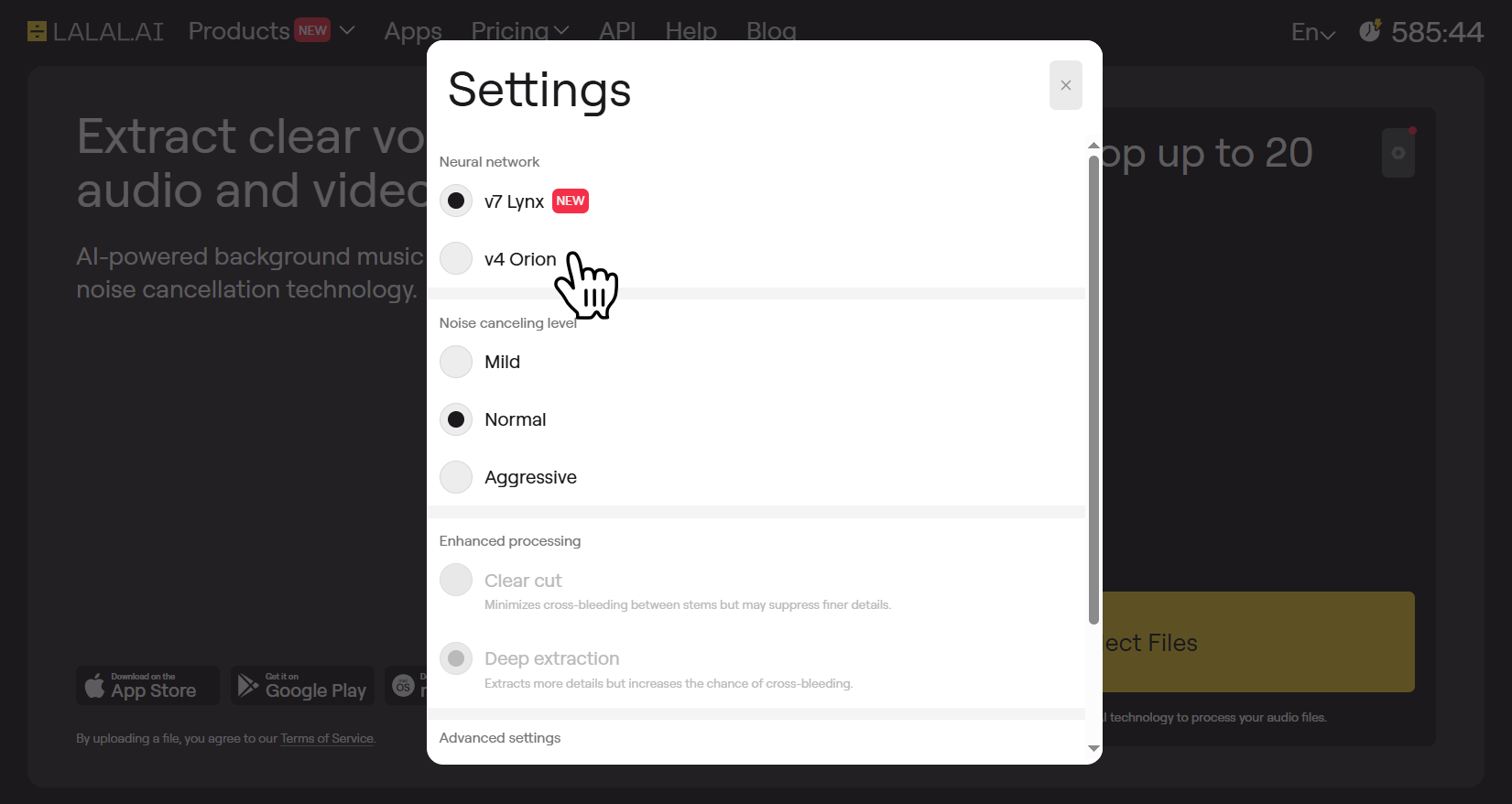
If you want to compare the result of Lynx and Orion in Stem Splitter or Vocal Cleaner, be sure to select the Voice and Noise stem before you go to settings.
30% Off Annual Pro
To mark the launch of Lynx, we’re taking 30% off the annual Pro plan from July 13 through July 28, 2026. If you’ve been considering an upgrade, this is a good moment to do it.
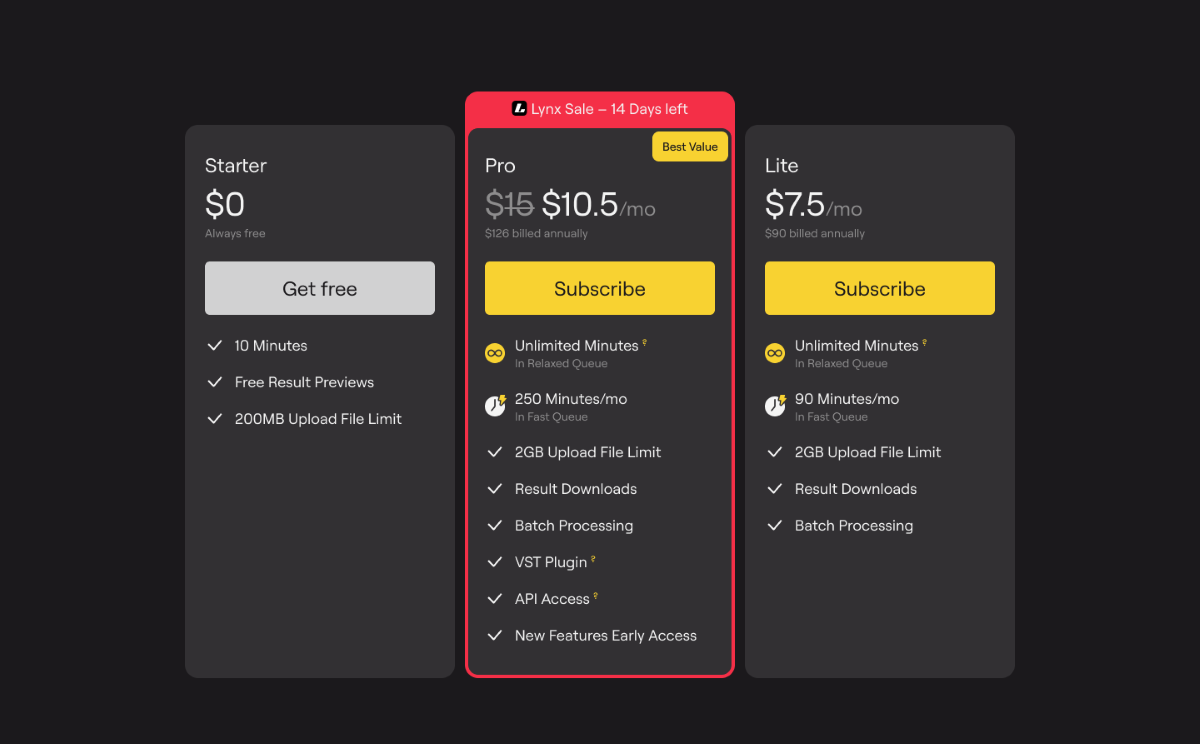
The annual Pro plan includes:
● Unlimited minutes in the Relaxed Queue
● 250 Fast Queue minutes every month, applied automatically before switching over to the Relaxed Queue
● Uploads up to 2GB per file
● Full result downloads and batch processing
● VST plugin access, so you can use LALAL.AI directly inside your DAW
● Local processing with Lyra (our on-device model) in the desktop app and VST plugin, which runs audio on your own device with no uploads and no minute credits used
● 3 Voice Pack Slots in Voice Cloner, so you can train, store, and swap cloned voices without buying new packs
● API access for building LALAL.AI into your own tools and workflows
● Early access to new features as they roll out
With the discount, the annual plan comes to $126 for the year instead of the usual $180, a savings of $54, and gives you plenty of room to put Lynx to work across the Vocal Remover, Stem Splitter, and Voice Cleaner tools.
The offer runs from July 13 to July 28, 2026. After that, pricing returns to normal, so if you’ve been on the fence, now’s the time.
Follow LALAL.AI on Instagram, Facebook, Twitter, TikTok, Reddit, and YouTube to keep up with all our updates and special offers.