"Every Engineer Should Have LALAL.AI" Interview with Paul Santa Maria
At 72, Paul Santa Maria, four-time Daytime Emmy winner and prolific composer, shares how he uses LALAL.AI to restore, remix, and reimagine decades of music.

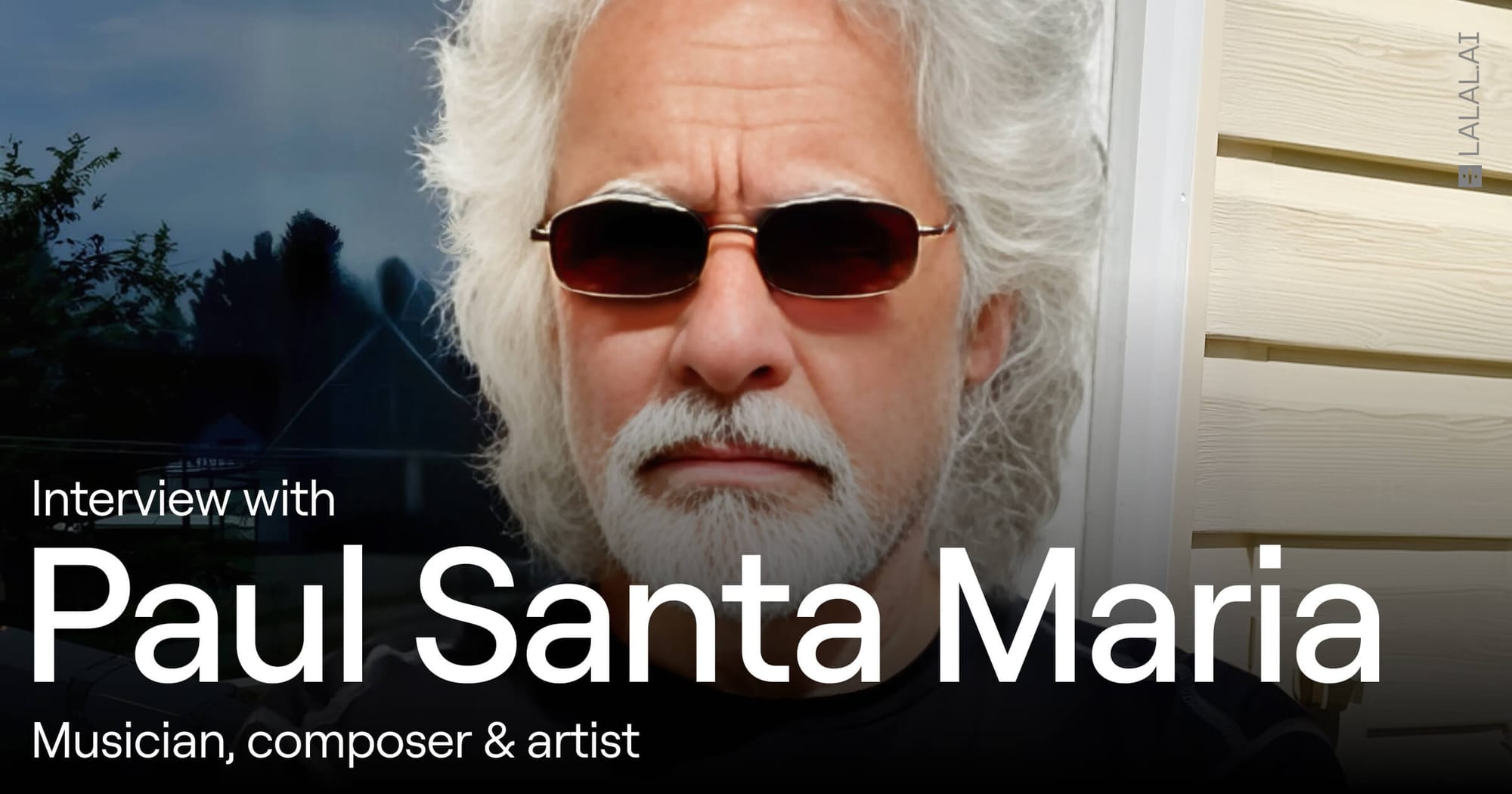
At 72, Paul Santa Maria shows no signs of slowing down. With decades of experience in music, composition, and visual art, he approaches creativity with the same curiosity and discipline as he did in his youth.
This time for our interview series, we sat down with Paul Santa Maria, a four-time Daytime Emmy Award winner, prolific composer, musician, and visual artist, to talk about a career spanning over six decades. From writing thousands of original pieces and best-selling instructional books to navigating the modern music production landscape, Paul has seen it all. We discussed his creative process, his perspective on AI in music, and how tools like LALAL.AI help him breathe new life into old recordings while pushing his work forward.
"It is simply that I was put on Earth to be an artist."
Paul has been playing guitar for 61 years, written a best-selling instructional book, The Guitar Explained, composed thousands pieces of music, and won the Daytime Emmy award four times! We couldn't help but ask Paul what drives him to keep creating at this pace.
I have coffee in my thinking chair in the dark. I let my mind roam, and it lands on something I should, could, might, or want to do, and then I do that! Start work by about 6:45 am after breakfast and finish around 4 pm when it’s time to become a boyfriend / human again.
It is simply that I was put here on Earth to be an artist. I am also a graphic and fine artist. I love putting pieces together, whether it be a drawing, painting, or musical piece. I have a small but powerful 24-track studio in my home, plus Sound Forge 15, Ozone 11 Mastering, and Melodyne Studio for music creation, and Photoshop 7.0 (1997!) with a Wacom graphic tablet, and that’s all I need for tools.
"Honestly, the only other outboard software I use is LALAL.AI... that’s the truth and not a product endorsement. Honestly, I love to create, to teach, to share, and that’s my human condition."
I am now up to 810 ASCAP-registered originals and have about another 75 tracks in my head, snippets, partials, and stuff that LALAL.AI is going to allow me to re-create.
This is the Guitar Madness demo I made for fun about 15 years ago that I forgot about and rediscovered yesterday morning. It is a piece with sequenced drums and bass on my Ensoniq ASR 10. I then put my guitar into the two audio tracks and played along with the sequenced part live!
For the LALAL.AI demo, I marked off four regions:
- Full 3-piece band
- Drums
- Bass
- Guitar
Then I copied and pasted it all together by overwriting the Part 1 demo, so that you can hear in real time the absolute separation, no crosstalk, etc.
And here I just added the bass and rhythm electric guitars to the LALAL.AI stems! Not bad for 3-hour work, including pre-mastering and mastering!
The stems I prepared from the Pauly Guitar Madness Demo were done with Andromeda, and I thought they were great stems, cleaner than usual.
This is the true beauty of being able to stem in the first place: keeping parts that still sound relevant and replacing others that are dated or distorted or unsalvageable with brand new ones.
My favorite stuff is everything I do. They are all so different; so many styles, it makes my own head spin a bit. My friends think I’m either nuts or a work monster — I just get up every day and record something, manage the catalogue or my website, along with everyday chores, duties, love, dogs, home, etc.
Speaking of those Emmy awards, I wrote and recorded music as an in-house project composer. I lived near the 3rd largest PBS station in the country (WPBT Ch.2, Miami) and thought that I should turn in a spec tape of some music snippets. About three weeks later, they called and asked if I would create two versions of “Happy Birthday” for their KidVision birthday club, where they would display the names of kids under about ten years old for fifteen days, depending on which half of the month you were born in, and do this all for free!
So I did four instead and had them to the station within 48 hours! They were so impressed that they offered me a monthly contract to produce three minutes of kids' background music for $150. I accepted. Over 8.5 years, I was occasionally asked to compose other kinds of music… but it was for four of these spots that won Daytime Emmys that I got that credit. It may be more by now, but I lost contact with them years ago, all the people I worked with are gone, and they don’t even know of me! They restructured, relocated to Boynton Beach, and have no answers to my questions. You can’t make this stuff up.
This is one of the ones I won a Daytime Emmy for; it's called "Death March" because it was composed and performed by me for a program on the last Romanov family for PBS. It is an approximation of what I thought "Russian" music should sound like... anyway, they loved it here!
An Old-School Ear in a Modern Production World
At 72, Paul Santa Maria comes from a generation that learned recording under hard technical constraints. Working with early Portastudios meant committing to decisions early and living with the consequences, a mindset very different from today’s “fix it later” workflows. That long perspective also gives him a pragmatic view on production quality today, especially when it comes to trusting new tools in broadcast-level work.
Working in a Tascam 244 Portastudio taught me how to plan the recordings like a general placing troops in war or some such analogy; I had to decide which tracks would be on 1, 2, and 3 to bounce to 4, then erase 1, 2, and 3 to make room for more.
Since 4 was mono, then 1 and 3 became my “stereo” possibilities, and 2 would also be mono for vocals. If anything else was needed in the center of the stereo field, then those parts would have to be recorded on 1 and 3, and while I was singing the lead, those tracks were left active and became fused with 2. For too many recordings, I did not save the original 1, 2, and 3 in my ignorance, and now LALAL.AI allows me to strip out those tracks and reassemble them in my 24-track machine. Then I can re-record stuff that isn’t great.
Everything that can go wrong in recording, I managed to do, especially vocals! I’m not a natural-born singer; I am a guitar and bass guy with a strong understanding of drums. So my old 1980s vocals are generally terrible and require much work. LALAL.AI works best in this order: vocals, drums, bass. I stem each song in that order, and then whatever else I can separate.
As I said, vocals, drums, and bass (in that order) are the most successful stems you'll get, so I save the vocals, and then the step one music result is "Band V1" (no vocals). The software does tell you in the title what was done, but this is a little simpler. So I know Band V2 means no drums, no bass — and just keep going, trying to get at that elusive track.
"LALAL.AI is incredibly inexpensive & every engineer should have it."
Since I found LALAL.AI (it’s been about three years), I have released probably 300+ songs. I had recently recovered all my Tascam 244 masters, but many songs were missing. Thankfully, I had mixes as I am very serious about the management of my catalogue, my life’s work. Many had been saved to DAT, then converted to .wav. So I had good stuff to work from. Only about five songs were beyond repair. But with the drum stems, I now had a click track! So I could re-record whatever was damaged. Thank you, LALAL.AI!
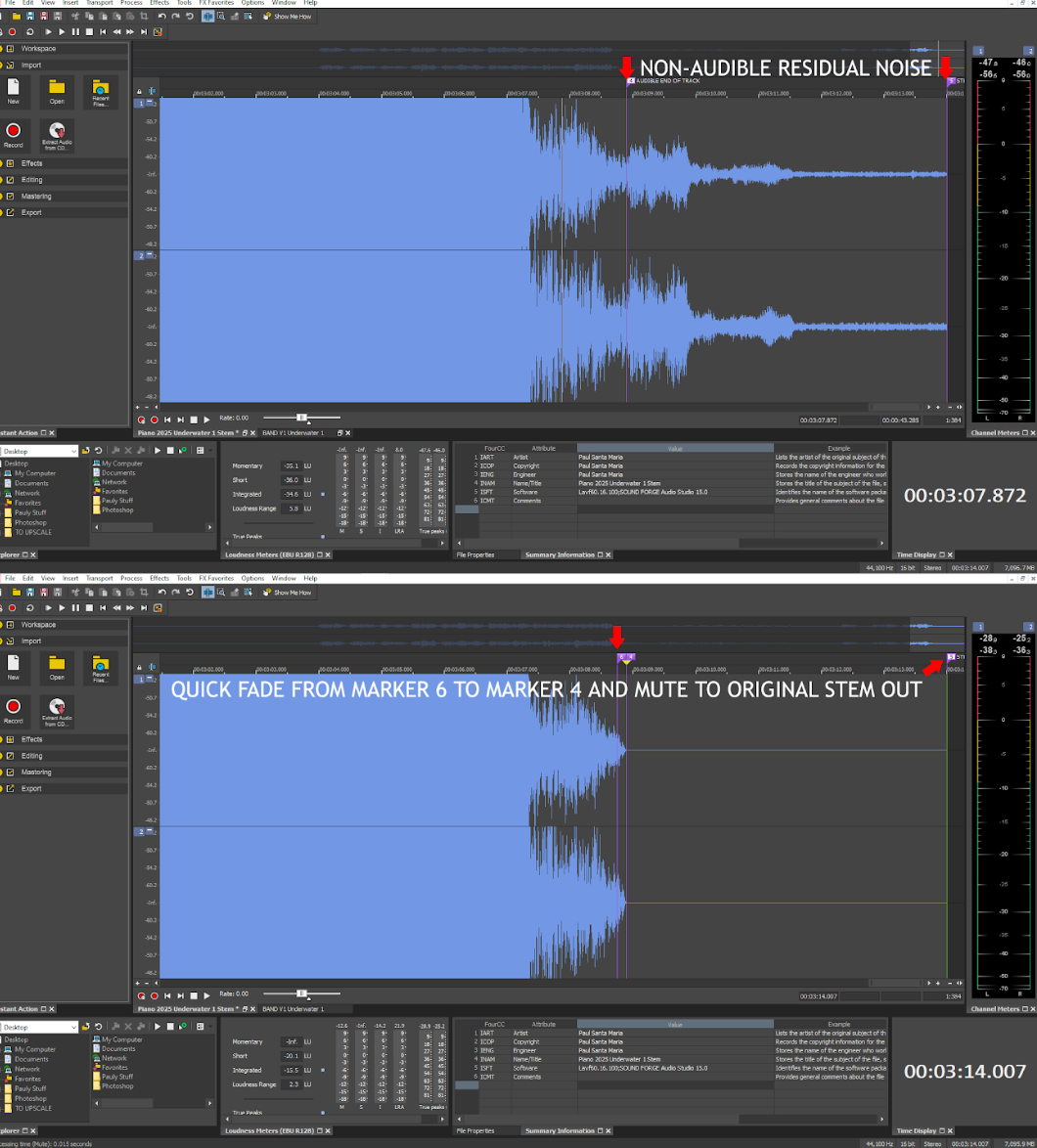
Before discovering LALAL.AI, I got really good at editing in Sound Forge! It was a serious headache trying to reduce P’s and B’s; I later discovered a tool in SF that reduces brightness quite effectively, but this is after stemming in LALAL.AI. Later, as LALAL.AI advanced, some of these things were corrected before I had to do it. I noticed an extreme drop in the incidence of P’s and B’s after Perseus.
A friend recorded his blues power trio in a studio in 1999 and wanted me to refurbish the whole thing with new parts as needed, reassembling and remastering it. Fortunately, it had never been mastered, so I used LALAL.AI to strip away everything. I did about six songs out of ten when I saw that Perseus had been added as a new algorithm, so I re-stemmed the vocals from the original track, and it was waaaaaay better!
In addition, the drums and bass were really weak for a power trio, so I simply re-inserted those final stems in my Tascam DP 24 (a great machine, when you know how to use it) and beefed everything up. I used the stereo maximizer in Ozone 10 to spread the drums out, because all the other instruments were technically mono (bass and guitar) and used reverb to give “stereo room” to the guitar and the bass straight mono.
There is just no way that I know of to stem like this that I can afford on my social security income, which is analogous to the income of a young person just starting out — that’s the reality of the dark side of independent distributors and giant platforms that pay you (IF they pay you) $00.000007623 a stream. TikTok has reported streams of up to 10,321 of one of my songs and paid me no money! Spotify is the same. Only Apple Music pays more, and they now pay 3 or 4 cents where they used to pay 60 for a download. So I have to flood the market with beautiful, funky, rockin’, children’s, etc. music to make a dollar!
"I warn my students: don’t try to play live, get a setup like mine (about $2500.00) and record. It’s a snake eating its own tail, but your software is your best friend and assistant."
"If you can’t hear the parts, you can’t make informed decisions. And without the stemmed track, you can’t use your million-dollar monitors to make those decisions in the first place."
After reacquiring my old masters (or when a client wants a recording spiffed up with my pretty amazing guitar skills), you can now make a track that was “lost” due to a creative decision by an engineer from the past, who maybe had very different gear than we have now, jump to the front or take its righteous place in the mix. I use two Kali IN-5 coincident studio monitors that wipe up the floor with anything that I know of in the same price range and maybe hundreds of dollars more expensive.
Can you get warmth and separation that warrants intrusion of EQ adjustments without spending thousands of dollars that the average person would never own? If you can’t hear the parts, then you can’t make informed decisions. So, without the stemmed track, it follows that you can’t use your million-dollar monitors to make those better decisions in the first place.
"LALAL.AI gives me the track, the monitors allow me to situate it best in the mix."
As long as there are pre-mixed recordings with no separate tracks to fiddle with to try to achieve perfection, then a tool like LALAL.AI is indispensable!
There are many times when it will "read" parts of a track that seem to get lost, like a snare drum or the top end of the EQ of a bass guitar. But I have found that it doesn’t delete this info; it got assigned or attached to another track because of confusion due to a poor recording. If you take a song apart and then reassemble it (to change levels, EQ, panning, use Melodyne to fix pitches on vocals, etc.), then amazingly those parts return! It’s weird, but true.
I am not answering these questions because I was asked to do that — I am not an influencer. If someone reading this says, “This guy is 72.5 years old — he’s not anybody I know, he’s a dinosaur”, then you’re just headstrong like I was at 21!
"Never devalue an older person simply for their age; surround yourself with older, smarter people, and they’ll save you years of wasted time."
"Don’t get hung up on the wrong side of AI."
Seriously, AI tools are just another highly usable tool like electric guitar pickups, microphones, or cars, for God’s sake. Don’t get hung up on the wrong side of AI, like replacing musicians and composers with trained, generated cumulative songwriting knowledge; use this for its actual design — digging into a mix and revealing the parts. Then move forward.
Note: Every track featured in the article is copyrighted 2025 Paul Santa Maria.