"It Felt Like Practicing Witchcraft": How Arena Sound Engineer Used LALAL.AI to Do the Impossible at London's O2
Arena sound engineer Danny Evans couldn't push 15,000 singing fans into the mix without ruining it. Here's how LALAL.AI changed that & rescued a documentary along the way.

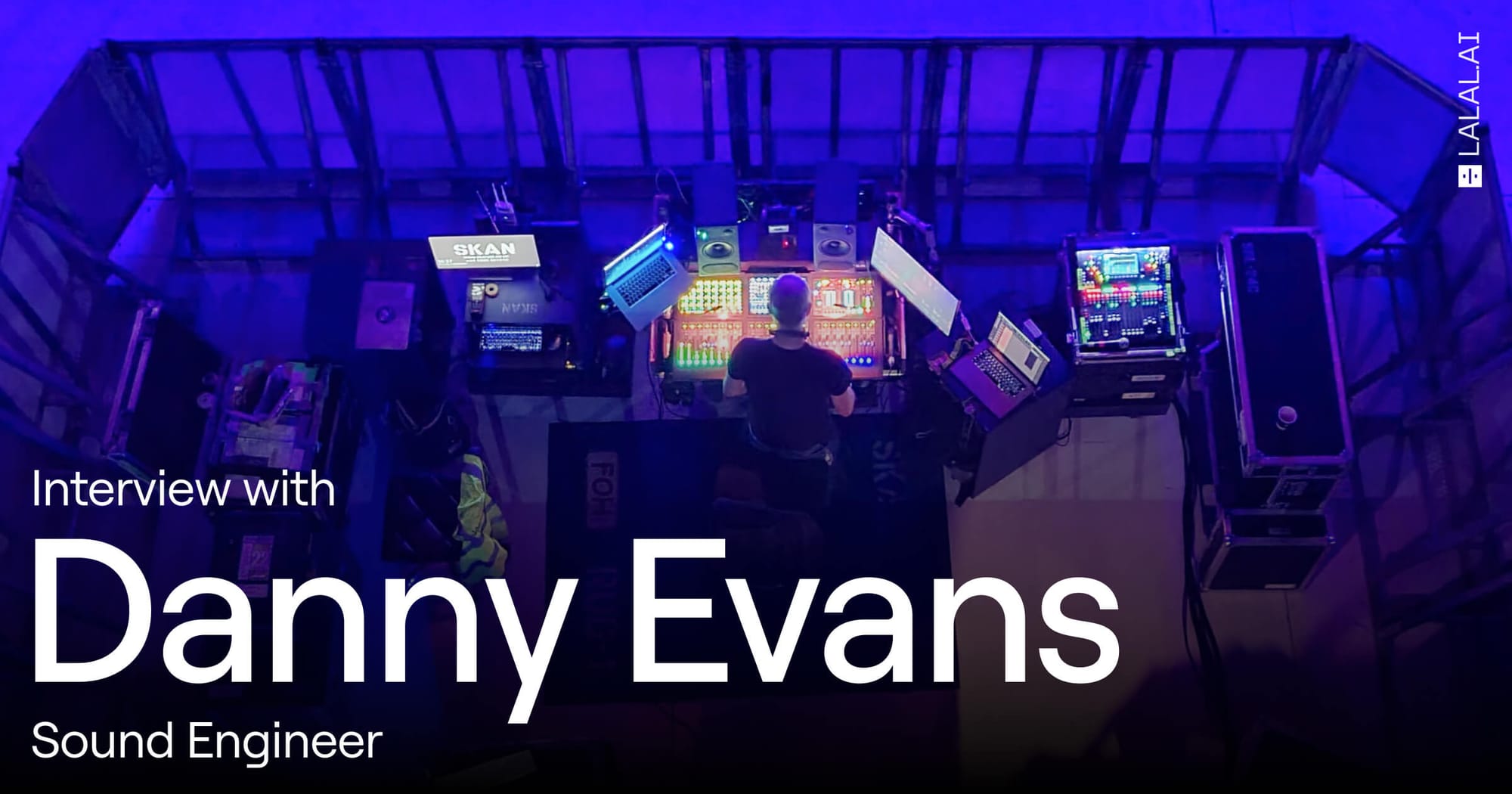
When Danny Evans is mixing a recording of a show at London's O2 Arena for elbow, he's managing 15,000 singing fans, a wall of PA sound, and a broadcast deadline, simultaneously. With 40 years of experience, including 25 years with elbow and tours across Africa, Papua New Guinea, and Japan, Danny has solved most live sound problems the hard way. But one kept coming back: crowd mics at arena shows always pick up everything (the PA, the stage sound, the room), which makes it nearly impossible to push the audience's voices in the broadcast mix without making the mix sound muddy.
Until he tried LALAL.AI, though. What followed, in his words, felt like practicing witchcraft.
From a Borrowed Tape Recorder to Arena Stages
I made my first recordings as a teenager in the early 80s, with a domestic reel-t0-reel tape recorder and a couple of mics, borrowed from a friend of my Dad’s. From the moment I realised I could do this as a career, I never wanted to do anything else.
The material I typically work with is album recordings, some live mixing, mixing recordings of live shows for release or broadcast, and audio post-production for films and documentaries. A bit of mastering once in a while. I started with New Fads (New Fast Automatic Daffodils) in the 80s, recorded with them in the studio and as their live engineer for several years, and worked with a lot of underground artists in the 80s and 90s, in various roles: Mc900ft Jesus, Fingathing, Frank Sidebottom, Mansun. I also did a couple of live tours with The Brand New Heavies.
I spent some time working on live events in Africa, Papua New Guinea and the Carribean, with artists such as Femi Kuti, King Sunny Ade, Ras Kimono and Maxi Priest. In fact, I just got back from a short tour in Japan and Hong Kong with Beth Gibbons, where I was depping for Rik Dowding mixing FOH sound.
"Homelife's 'Flying Wonders/Wobbly Jack' EP — it was just an honour to be involved in a recording with so many incredible musicians."
elbow’s last three studio albums have particularly stood out for me. Audio Vertigo and the subsequent EP release were very strong, but the previous album, Flying Dream 1, written and recorded in quite unusual circumstances during and in between the lockdowns of 2020 and 2021, that has some very vivid memories for me.
The final recordings were made in the Theatre Royal in Brighton. I shipped the whole studio down there in a truck for that one.
Separating 15,000 Voices from a Wall of Sound at London's O2
For the last 25 years, I’ve been working with elbow. I mix FOH sound, which starts with advising on or programming patches on the keyboard, bass and guitar rigs, and having a technical overview of everything that goes on on-stage with the backline. I routinely multi-track their shows so I can review and adjust backline sounds or the live mix using the "virtual soundcheck" i.e. replaying the multi-track back through the mixing desk before the band actually soundcheck. So making multi-track recordings of the shows is just part of the workflow now for most live engineers.
The direct sources from the band are pretty much taken care of as we’ll have the mics in place for the live requirement anyway. From the live sound point of view, my main concerns are regarding the acoustics of the venue. With the advent of modern Line Array technology, and in particular the d&b GSL and KSL PA systems, the effect of a poor acoustic is greatly reduced, as it’s possible to direct the sound more accurately at the crowd, reducing the negative effects of the acoustic ambience of the room.
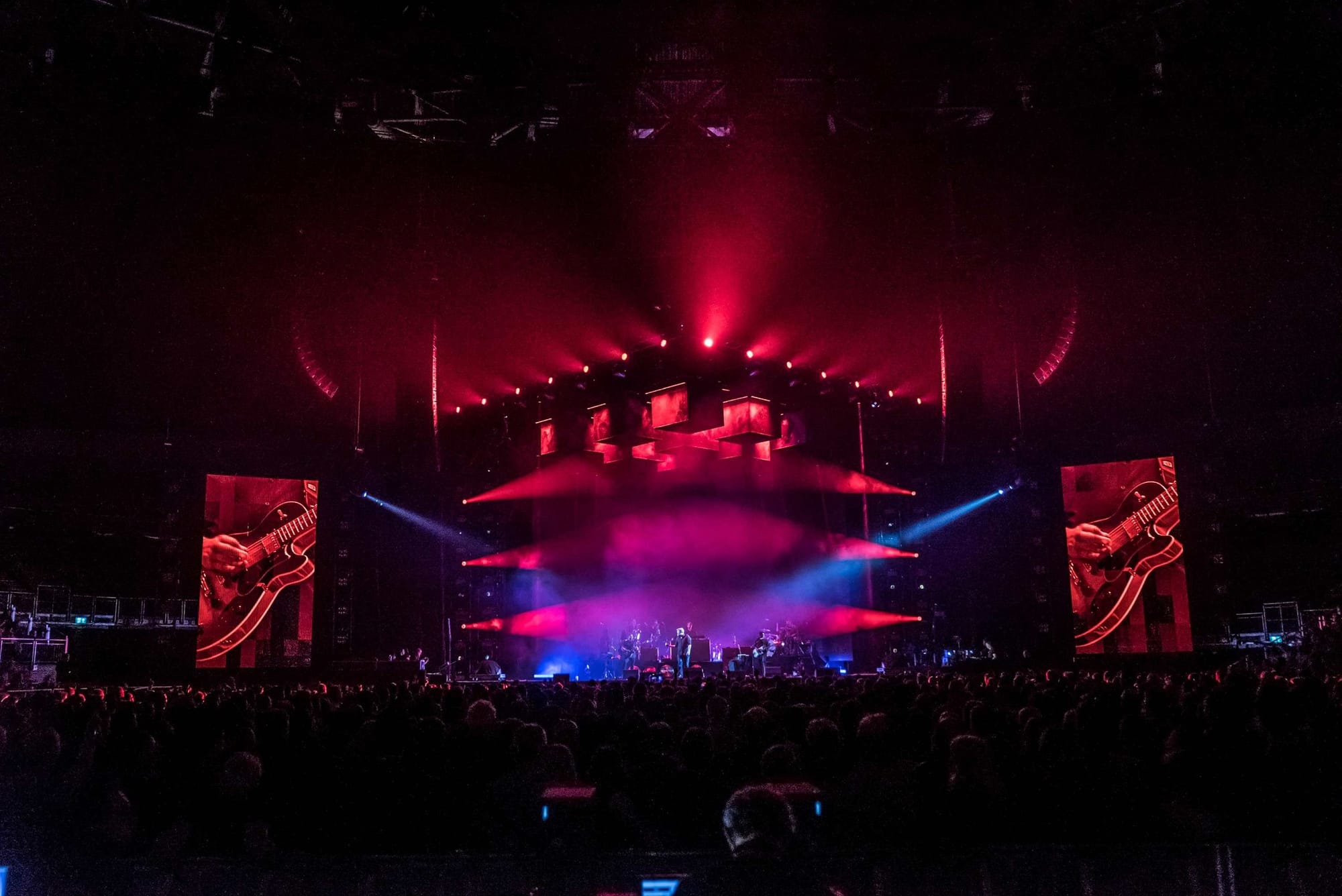
In terms of recording the show for broadcast, it comes down to how I capture the crowd's ambience. Obviously, you can’t experiment with mic choices or placement like you could in the studio, as it's a one off event. I asked our supplier, Skan, to supply 4x Sennheiser MKH416 shotgun mics and placed these on a lighting truss high up and between the main PA hangs, directly above the downstage edge of the stage in two coincident pairs, one pointed down at the front rows of the crowd (which are always the liveliest!) and one pair more towards the rear, to capture more of the overall crowd ambience.
I was very happy with the results, it was a great starting point, but even so, when the crowd are singing during the louder songs in elbow’s set, it's very difficult to get the crowd high enough in the mix: the louder you push the crowd mics, the more spill from the PA and the stage sound you have, and it gets to a point where you’re just making the whole mix sound muddy because of this additional ambience.
“It kind of felt like I was practicing witchcraft”
There was one particularly loud song where, even though the crowd were singing quite loudly, I couldn’t get them up as loud as I would like in the broadcast mix, and having used LALAL.AI on a couple of different projects, I decided to experiment.
I put the ambience tracks into LALAL.AI and chose the vocal and instrument separation. As I remember, LALAL.AI had just introduced an algorithm to separate lead vocal from BVs, which helped to further separate the spill from Guy’s lead vocal from the crowd, which was recognised as BVs.
With such a complex signal, with so much room ambience, it was a little hit and miss, but for the most part I was able to split the ambience into three stems: instrumental ambience and lead vocal ambience, which I left at more or less the same level throughout, and crowd ambience, which I could ride and push in level without unduly affecting the quality of the mix. It kind of felt like I was practicing witchcraft at that point! It wasn’t perfect, and I did have to use a few other tricks, but it was 90% there.
"Even though I rarely get into details with my clients about the technical process, the clients have been happy with the results."
Previously, all that I could do was choose the most appropriate, very directional mics and the best placement for them for the recording. Then use EQ and fader automation in the mix to reduce the negative audio impact when the crowd response was not required, and boost the level when the crowd response was required, but there's always a compromise.
Even with the best choice of mics and mic placement, there will always be a lot of the sound of the PA and the live stage sound, which has a very negative impact on the mix of the band if pushed too high in the mix.
Rebuilding a Voice That Wasn't Fixable
Stem separation wasn't the only place where Danny pushed LALAL.AI beyond its obvious use case. Working on a documentary, he ran into a different kind of problem, one where no amount of EQ or traditional repair could help. So he turned to Voice Cloner, and the result surprised even him.
I recently mixed the audio for a documentary. The original recording of the interviewer’s voice was occasionally very distorted, clipping on many of the audio takes. I tried using some more traditional techniques to eliminate this, but with limited success on certain key words. I used the Voice Cloner in LALAL.AI: I put together 30 minutes or so of the original interviewer’s voice recordings from previous projects I had worked on with her, and some interviews I found on YouTube to train the AI, and then used this AI cloned voice to replace the original, distorted audio on the specific words where the distortion had been unrepairable.
"The results were seamless, and totally rescued the project from an audio point of view."
Even the original voice artist/interviewer did not notice it wasn’t, in fact, her original voice.
LALAL.AI has enabled me to do certain things that simply would not have been possible before. It is a very interesting new tool in the toolbox, and with a bit of imagination, it can do some cool stuff it maybe wasn’t really designed for. I’m very interested to see how it evolves!
Follow LALAL.AI on Instagram, Facebook, Twitter, TikTok, Reddit, LinkedIn, and YouTube to keep up with all our updates and special offers.