4 Producer Tools to Beat Writer’s Block (Guest Article)
Struggling with writer’s block? Discover these four tools that help music producers spark ideas and start new tracks faster.

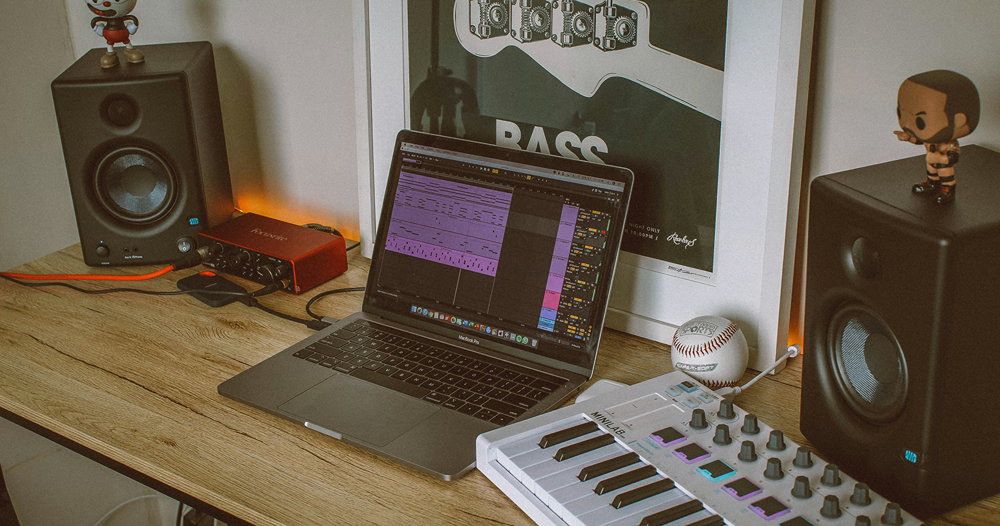
Writer's block isn't a rare problem for beginners. It affects touring artists, bedroom producers, conservatory-trained composers, and independent songwriters alike. Whether you create in a DAW, at a piano, or through a loop station, the experience is the same: ideas stall, momentum disappears, and self-doubt grows louder than the music itself.
In the streaming era, the pressure has intensified structurally. Artists now face a new anxiety that previous generations never had to navigate: "If I don't release a single every five to six weeks, I'm not pinging that algorithm and my monthly listeners are going to decrease," as per Music Ally.
The consequences are measurable: with roughly 100,000 tracks uploaded to Spotify daily, the market is exponentially saturated, and the majority of content never gets heard, which only deepens the burnout cycle for producers who feel compelled to release constantly.
The neuroscience behind the block is also well-documented. As neuropsychologist Donald Hebb established in 1949, "cells that fire together, wire together", meaning that if you solve a creative problem a certain way, your brain is neurologically wired to repeat the same approach next time. Modern producers fall into habitual workflows precisely because their brains have been trained to do so.
Breaking that loop often requires a new tool, a new environment, or a new method of listening, not just willpower.
Writer's block is also rarely about having no ideas at all. It is more often about friction: psychological, technical, emotional, or environmental. When those layers are unpacked, the block becomes something you can work with rather than something that controls you.
Quick Reference: What Each Tool Is Best For
Here's a summary of the four tools covered in this article: what problem each solves, the learning curve involved, and the type of producer who will benefit most.
|
Tool |
Primary use case |
Best for |
Learning curve |
Free tier? |
|
LALAL.AI |
AI stem separation |
Remixers, beat-flippers, sample-based producers |
Low |
Yes (10 min preview) |
|
Jukeblocks |
DAW templates + arrangement from loops |
Producers stuck at the 8-bar loop stage |
Low |
Limited |
|
Auris Ear Training |
Melody & chord recognition exercises |
All producers wanting to sharpen melodic instincts |
Medium |
Yes |
|
Sample Libraries (Mode Audio, Ueberschall) |
Loops and one-shots for layering or inspiration |
Producers struggling with arrangement or texture |
Low |
Varies by library |
1. LALAL.AI: Deconstruct to Reconstruct
One approach to breaking writer’s block is to take an existing track and completely rethink it.
That's the core premise of stem separation, and LALAL.AI has become the leading tool in that space. With stem separation tools, you can isolate vocals, drums, bass, or other elements from a song and use them as inspiration for something new.
What LALAL.AI Actually Does?
LALAL.AI's neural network processes stereo audio input and transforms it into separate stems. In practical terms, you upload a finished track and receive isolated stems: vocals, drums, bass, piano, electric guitar, acoustic guitar, or synthesizer, wind instruments or strings, depending on the separation type you select.
Andromeda is LALAL.AI's sixth-generation neural network and the most technically advanced model the company has built. Like its predecessor Perseus, it uses transformer architecture but with approximately four times the training data and multiple structural improvements that yield faster and more reliable results. Andromeda analyzes audio not just as a single waveform but across time, frequency, and tonal dimensions simultaneously, registering timbre composition, resonance depth, and instrument presence across the stereo field.
For the first time in LALAL.AI's history, users no longer face a trade-off between detail extraction and cross-bleed prevention, the two competing failure modes that plagued earlier generations of stem separation. Compared to the prior-generation Perseus model, Andromeda delivers up to 40% faster processing while maintaining separation quality.
A key architectural decision worth noting: drums, bass, vocals, and instrumental stems now all run inside the same neural network rather than being handled by separate legacy models. When different stems are processed by different models, you get different artifact signatures — the bass model might smear transients differently than the vocal model handles sibilance, making it harder to reassemble a coherent mix from stems with mismatched characteristics. A unified architecture removes that problem.
The platform's quality has been independently validated. In December 2025, Meta's independent stem separation benchmark ranked LALAL.AI as the top commercial technology in the Pro category. MusicRadar's independent review awarded the platform a 5 out of 5 score for both vocal and drum extraction. At the 2026 Webby Awards, LALAL.AI was recognized as a Top 5 nominee for Best Use of AI and Machine Learning.
How to use LALAL.AI creatively against writer's block
There are several approaches worth experimenting with:
- Extract just the vocal from a track you love and build a completely new instrumental around it, then remove the vocal. You end up with an original chord progression, groove, and arrangement that you likely wouldn't have arrived at from a blank session.
- Take out one element (say, the drums) and fill the gap yourself. This constrains the creative task to a specific role rather than asking you to invent everything at once.
- Use an isolated bassline as a harmonic compass. Build chords above it. This is a particularly effective technique for producers who struggle to start with harmony.
Platforms where LALAL.AI is available
LALAL.AI launched as a browser-based platform in 2020 and has since expanded to desktop and mobile apps, voice cloning, and reverb removal tools. In early 2026, the company released its first DAW plugin, a VST3 that runs a local AI model and handles stem separation directly inside your session, available to Pro subscribers.
2. Jukeblocks — Get Past the Blank Session and the 8-Bar Loop
Sometimes the hardest part of producing is simply starting a project. A fresh session with nothing in it can feel intimidating and many producers get stuck on a short loop, but as Alvin Toffler described in Future Shock, too many choices can be crippling. Cognitive overload stops creators from starting at all.
Jukeblocks addresses this in three practical ways:
- Generate a DAW template.
Instead of opening an empty project, you start with a structured template — channel routing, some initial arrangement blocks, genre context that gives your brain a constraint to react to rather than a void to fill. Constraints, counterintuitively, tend to increase creative output. Directors like Lars von Trier have long understood this: the Dogma 95 movement deliberately imposed restrictive rules on filmmaking, no artificial lighting, no non-diegetic music, precisely because limitations force creative problem-solving that freedom doesn't.
- Expand a loop into a full arrangement.
This is arguably the most useful feature for producers who have hard drives full of 8-bar ideas that never became songs. You upload a loop, select a genre, and the tool generates a full arrangement structure from it. The result isn't a finished track, it's a scaffolding that shows you how the loop could breathe across an intro, build, drop, and breakdown. You then edit, replace, and extend from there.
- Switch DAWs.
This sounds superficial, but the research supports it. Switching your creative environment resets habitual neural pathways. If your brain has spent years associating Ableton Live with a specific workflow, working in FL Studio or Logic even for a single session can produce genuinely different ideas, because your hands can't fall into the same muscle memory.
3. Auris Ear Training — The Underrated Creativity Tool
Training your ears can also be a surprisingly good creativity exercise. When you actively listen and reproduce melodies or chords, you start hearing musical ideas in a different way.
The creative case for ear training
One of the most effective ways to generate new ideas is to analyze the elements that make existing songs compelling. With a solid foundation in ear training, a producer can recognize the chords and melodies in existing tracks, unlocking a whole new world of inspiration, rather than staring at a blank piano roll hoping something comes.
There's also a direct link to execution speed. If you can hear the big picture, the harmonic structure, the melodic contour, how one element relates to another, your music-making becomes less hit-and-miss. Producers with trained ears can identify the components of arrangements they admire and apply those structural ideas intentionally rather than by accident.
What Auris specifically offers
The app runs structured exercises in two main areas:
- Melody recognition. You hear a short melodic phrase and reproduce it. The intervals gradually increase in complexity. Beyond the ear training benefit itself, the side effect is exposure to a large number of random melodic fragments, many of which will stick as seeds for your own productions.
- Chord progression recognition. You identify the progressions used in short musical passages. This is directly applicable to production: knowing that a track you love uses a I–IV–vi–V loop in a specific voicing is far more useful than vaguely sensing that it "sounds good."
Peer-reviewed research from 2025 published in Sage Journals found that ear training activities designed around 21st-century creative frameworks, including collaborative games, dictation from varied instrument sounds, and story-based exercises, aligned strongly with core creative competencies: critical thinking, creativity, collaboration, and technological literacy.
How long does it take to see results?
Consistent daily practice of even 10–15 minutes produces audible improvement within a few weeks for most producers. The key is regularity over intensity: ear training is a skill that won't develop overnight, and starting over is harder than maintaining momentum.
4. Sample Libraries — The Strategic Use of Loops
Exploring new samples is a very effective way to spark your creativity. The real power lies in finding hidden gems.
Why samples work against creative block
Rather than facing a blank session with infinite choices, a single loop gives your brain something to react to. You're no longer composing from nothing, you're in dialogue with something that already has a groove, a key, a texture. Dragging an audio reference into your project and writing music around it, even if you remove it later, is one of the most widely used strategies among experienced electronic producers precisely because it eliminates the blank-slate problem.
Specific techniques:
- If your track sounds thin, import a loop and layer it over your draft. Don't replace what you have — stack it underneath and listen to what opens up. A drum loop added to programmed drums often fills frequency gaps you didn't know existed.
- Play along with a simple drum loop and bassline and improvise chords over the top. Record everything. The spontaneity of playing rather than programming often generates ideas that a piano roll workflow suppresses.
- Use loops strategically in your weak areas. If harmony is difficult, start with a chord loop as a harmonic foundation and build everything else around it. If rhythm is your strength, start there and let it inform the rest.
Where to find quality material
Mode Audio and Ueberschall are reliable starting points for high-quality, well-organized libraries. Beyond those, royalty-free sample libraries with a strong curation philosophy, rather than simply a high track count, tends to produce better results. The goal is density of usable material, not volume of files.
Frequently Asked Questions
What exactly is writer's block in music production?
Writer's block in music production is a condition in which a producer loses the ability to create new work, or experiences a loss of concentration on existing work. It differs from exhaustion: when you're exhausted, you lack the will to work; when you're experiencing writer's block, you have the will but simply lack the ability to proceed.
Does writer's block affect experienced producers too, or just beginners?
Even the most experienced music producers and artists experience creative block. Writer's block is, in essence, the fear of creating something less than perfect, a psychological condition tied to perfectionism rather than a lack of skill. Many celebrated producers, including those responsible for commercial hits, have publicly discussed extended dry periods.
Is it better to push through writer's block or take a break?
Both approaches have merit depending on the type of block. Many musicians confuse idea generation with idea development. They believe they're blocked because they can't produce a finished piece in one sitting, when in reality they may be generating raw material but rejecting it before allowing it to evolve. Professional composers rarely rely on inspiration alone; they build systems for developing fragments into complete works. For this type of block, pushing through with a structured constraint is more effective. For burnout-driven blocks, stepping away is the better option.
Why do producers get stuck at 8-bar loops?
Many producers find starting tracks overwhelming and difficult, and when they do start and make progress, finishing them seems like an impossible task. The 8-bar loop feels complete and satisfying on its own, which makes extending it feel risky. The solution is usually structural: use an arrangement template or reference track to make the path from loop to full song concrete rather than abstract.
How is stem separation useful if I don't want to make remixes?
Stem separation is a research and inspiration tool as much as a remix tool. Isolating a vocal or a bass part lets you hear exactly how it was performed and produced, the timing, the texture, the processing, in ways that listening to the full mix doesn't reveal. Many producers use separated stems to reverse-engineer techniques from tracks they admire, without ever intending to release a remix.
Does ear training actually help with music production, or is it mainly for classical musicians?
The role of "producer" has evolved to mean a technician and artist who creates rather than merely captures a musical performance. Both musical and audio ear training are a prerequisite to experiencing creative success in this role. Understanding where different instruments sit in a mix, the frequencies required to alter the timbre of a part, and the right settings to dial in a plugin quickly are all skills that expedite a producer's workflow and shift focus from technical guesswork toward actual music-making.
Final Thoughts
Writer's block comes in many forms; some producers feel they lack inspiration, some burn out from industry pressure, some struggle with focus, and some face challenges related to their technical abilities. Many of these reasons intersect, which is why the forms of creative block are somewhat endless. That's also why a single solution rarely works for every producer or every situation.
The four tools covered here address four distinct entry points: deconstructing existing music (LALAL.AI), eliminating the blank session (Jukeblocks), training the ear to hear new ideas (Auris), and reducing the creative load through structured starting points (sample libraries). The most effective approach is usually to rotate between them, using whichever removes the most friction at the specific point where you're stuck.
Follow LALAL.AI on Instagram, Facebook, Twitter, TikTok, Reddit, LinkedIn, and YouTube to keep up with all our updates and special offers.