World Cup Songs: How Official Anthems Are Made & Why Fans Sing Something Else
Every World Cup has two soundtracks: the anthem FIFA produces and the chant fans choose. Here's how both are made and why the stands always win.

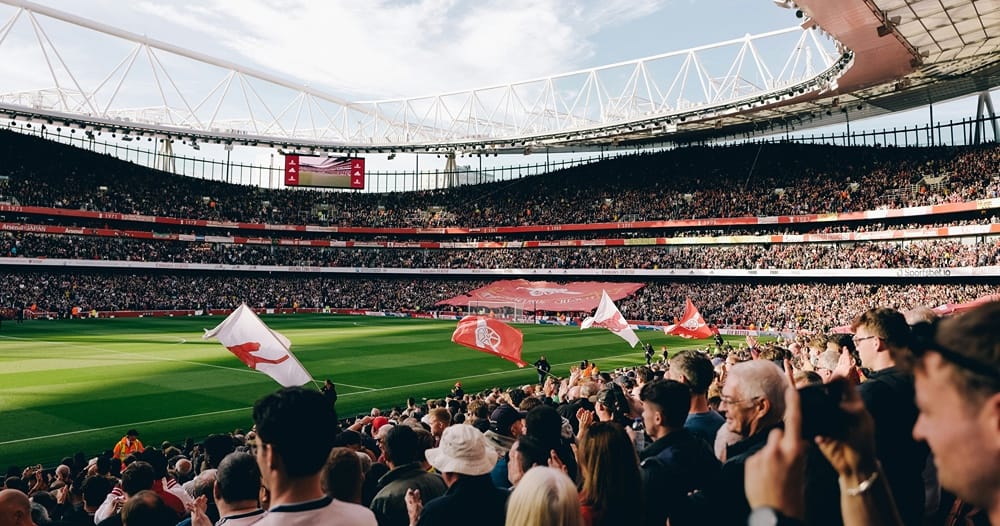
On June 11, 2026, the World Cup opens at Estadio Azteca in Mexico City, with Mexico facing South Africa, the first match of the first 48-team tournament in history. Over the PA, fans are hearing "Dai Dai," the official song of the tournament performed by Shakira and Burna Boy, unveiled by FIFA in May as a celebration of football, culture and global unity.
But listen past the speakers, into the stands, and you'll hear something else entirely. A seven-note riff from a 2003 garage-rock record or 1996 Eurodance chorus with the words swapped out. Melodies nobody at FIFA commissioned, licensed, or approved.
Every World Cup has two soundtracks. One is written in studios, produced by Grammy winners, and released on schedule with a music video. The other is sometimes written by no one in particular, in pubs and on terraces, and released the moment fifty thousand people decide a tune is worth singing. The first soundtrack costs millions. The second one can't be bought, and it's usually the one history remembers.
This is the story of both, and of what happens, technically and culturally, when a song leaves the studio and meets a stadium.
The Anthem Industry: How an Official Song Is Made
The official World Cup song is one of the most coveted commissions in pop music, and 2026 shows how industrialized the format has become. Instead of a single anthem, FIFA released an Official FIFA World Cup 2026 Album with 18 tracks, the most extensive music project ever created for a World Cup, featuring artists from across continents, languages and genres.
The rollout was engineered like a product launch. The first single, "Lighter," was announced in March 2026 by FIFA president Gianni Infantino and deliberately stitched together the three host nations: American star Jelly Roll on vocals alongside Mexican performer Carín León, with production by Cirkut, a Canadian who won the 2026 Grammy for Producer of the Year.
Then came "Dai Dai" by Shakira and Burna Boy on May 15, the official tournament song, which also serves as the theme for the FIFA Education Fund followed on May 21 by "Goals," a LISA, Anitta and Rema collaboration fusing Latin pop, K-pop and Afrobeats, slated for its live debut at the tournament's Los Angeles opening ceremony.
But how does a song like this actually get written? The most successful one in history started with a walk. Shakira has described conceiving "Waka Waka" while spending the holidays at her farm in Uruguay: the verse melody arrived, words and all, as she walked from the barn to the house, "like someone was dictating it from above," she told Billboard, and she immediately called Sony to say she'd written the World Cup song. The finished track was co-written with producer John Hill and built on a sample of "Zamina mina (Zangaléwa)," a Cameroonian makossa song by Golden Sounds, grounding a global pop single in the host continent's musical heritage.
And that's just FIFA's own catalog. Sponsors run a parallel anthem economy: Coca-Cola, a World Cup sponsor since 1978, released "JUMP", a reimagining of Van Halen's 1984 hit performed by J Balvin and Amber Mark with guitarist Steve Vai and blink-182 drummer Travis Barker, continuing a lineage that includes K'naan's "Wavin' Flag" (2010), Jason Derulo's "Colors" (2018) and a reworking of Queen's "A Kind of Magic" (2022).
The commercial ceiling for this format was set sixteen years ago. "Waka Waka (This Time for Africa)" by Shakira featuring South African band Freshlyground — the official song of the 2010 World Cup — sold more than one million copies during the four weeks of the tournament alone, which made it the fastest and biggest-selling World Cup single of the digital age, and hit #1 in 15 countries.
It has since passed one billion streams on Spotify, a Guinness World Record for a World Cup song and its video has been viewed more than 4 billion times on YouTube.
So the machine works. The songs chart, the videos rack up billions of views, the brand associations stick. And yet, walk into almost any stadium during the tournament, and the crowd will be singing something else.
Anatomy of a Stadium Hit: What the Crowd Can Actually Sing
Why do some melodies survive contact with 80,000 people and terrible acoustics, while professionally engineered anthems don't? It turns out the answer is partly measurable, and it has more to do with melodic architecture than with production budgets.
Researchers and vocal experts who have studied football chants point to a few consistent properties. First, radical melodic simplicity. Kay Kaufman Shelemay, an ethnomusicology professor at Harvard, notes that simple melodies are essential to football chants because fans can remember them instantly and sing them in a loop: the "Olé" chant is a 12-note riff; "Seven Nation Army" is just seven notes.
Second, stepwise motion. Juilliard voice teacher Robert White explains that crowds chant most easily when melodies move up or down the scale one note at a time; the biggest interval leap in both "Olé" and "Seven Nation Army" is a third.
In other words: a chant has to be singable by people who can't sing, in unison, at full volume, while jumping.
Third, the hook must work with no words and no instruments. The Italian fans who turned "Seven Nation Army" into a national anthem in 2006 famously didn't know its lyrics or even its name. It was simply the "oh oh oh oh oh oh oh" song. Strip away the vocal, the production, the arrangement, and if the bare melodic line still carries, that's stadium material. Musicologists describe what fans do next with a term borrowed from medieval music: contrafactum — putting new words to an existing melody.
There's also fresh academic work on this. A 2026 study by Nicolai Jørgensgaard Graakjær maps how stadium sound differs across football cultures: in England, it's dominated by spontaneous communal singing, with well-known pop melodies given new lyrics in short, intense bursts; in Germany, sound is more organized and sustained, driven by drums and chant leaders into a constant wall of sound.
Look at official anthems through this lens and the gap becomes obvious. A track like "Goals", built by four producers, layering Latin pop, K-pop and Afrobeats across multiple languages, is optimized for streaming playlists and opening ceremonies, not for a tuneless crowd in a concrete bowl. The production polish that makes a song chart is often exactly what makes it unsingable at scale.
The Chant Phenomenon: Why Fans Choose Their Own Anthem
The two most famous fan anthems in modern football were never meant to be anthems at all, and their origin stories explain why no marketing department can replicate them.
Seven Nation Army
The White Stripes released it in 2003; it debuted at a modest #76 on the Billboard Hot 100. Its second life began on October 22, 2003, when Club Brugge fans, drinking in a Milan bar before a Champions League match against AC Milan, heard the song and carried its riff into the San Siro. Brugge pulled off a 1-0 upset, and the riff became the club's unofficial anthem.
In February 2006, AS Roma fans heard it at a match in Bruges, took it home, and by that summer it had become the soundtrack of Italy's World Cup run, sung as "Campioni del mondo" through the streets after the final in Berlin.
Jack White's reaction was:
"I am honored that the Italians have adopted this song as their own. I love that most people who are chanting it have no idea where it came from. Nothing is more beautiful than when people embrace a melody and allow it to enter the pantheon of folk music."
Within a year the riff had jumped to American college football via Penn State, then to the NFL, NBA and NHL.
Freed from Desire
Gala's 1996 Eurodance hit was resurrected in 2016 when Wigan Athletic supporter Sean Kennedy uploaded a YouTube video reworking the chorus for the club's in-form striker: "Will Grigg's on fire, your defence is terrified." The chant went viral, was recorded as a single that reached #76 on the UK chart, and traveled with Northern Ireland fans to Euro 2016 where it became the tournament's unofficial song.
The punchline: Grigg never played a single minute of the tournament but it didn't matter. Fans across Europe plugged their own players into the template, like "Vardy's on fire," "Grizi's on fire", and the melody became infrastructure. By Euro 2024, it was being played at the end of every match, and clubs from Manchester City to Napoli have adopted it.
Notice what these stories have in common? Neither song was pushed from above. Both spread peer-to-peer (bar to terrace, terrace to terrace, country to country), selected by crowds for pure singability and then rewritten freely, like... folk music. Researchers studying football chants make exactly this point: chants circulate orally, exist in many variants, and leave their authors unknown, that's the defining traits of folklore.
An official anthem is a product but a chant is a commons. That's why FIFA can release 18 tracks and still not control what the tournament actually sounds like.
The Audio Bottleneck: Where the Two Soundtracks Collide in Post
For the people who work with World Cup sound professionally (we mean broadcast teams, club media departments, documentary editors, creators cutting fan-culture content) the stadium's two soundtracks are a daily technical problem.
Consider what a raw stadium recording actually contains: a chant you want, bleeding into PA music you don't have rights to. Or a pitch-side interview buried under 70,000 voices. Or commentary tracked in a booth that still picks up the roar. Or fan-shot footage where the moment is perfect but the audio is a wash of reverb bouncing off a concrete bowl. Every piece of content built from tournament atmosphere starts with the same job: pulling the layers apart.
This is where AI source separation has quietly become part of the workflow. Tools like LALAL.AI's Voice Cleaner isolate speech from background noise, turning an unusable pitch-side clip into a clean interview bed, or extracting the crowd's vocal layer when that's the texture you actually want. The Echo & Reverb Remover addresses the stadium's signature problem: the long, smearing reflections of a giant enclosed space that make location audio sound distant and hollow. For editors, the practical shift is that "we can't use that audio" increasingly becomes "we can use exactly the part of that audio we need."
There's a rights dimension too. Because official anthems and PA music are licensed commercial recordings, content teams often need to remove music from their footage rather than clear it, keeping the crowd, the commentary, the ambience, and losing the copyrighted track underneath. That, for instance, is what Slate's customers do with LALAL.AI Voice Cleaner integrated into the Slate content platform via API. Source separation makes that a routine step instead of a dealbreaker.
The stadium will never deliver clean stems, so post-production is where the tournament's real soundtrack (the one the crowd wrote) gets rescued from the noise.
The Soundtrack You Can't Produce
By July 19, when the final kicks off at MetLife Stadium, "Dai Dai" will have been performed, broadcast and streamed countless times. The 18-track album will have done its commercial job. And somewhere in the stands, a melody nobody planned will have already won.
Maybe it will be the seven notes that have ruled stadiums for two decades. Maybe a 1996 dance chorus with brand-new words. Maybe something that, right now, is just a song playing in a bar near a stadium in Monterrey or Toronto, waiting for the right group of fans and the right 1-0 upset.
FIFA can produce an anthem. Only a crowd can produce the anthem. The most interesting sound of this World Cup hasn't been recorded yet, and when it is, it will be recorded badly, on phones, in echo and noise, by the people singing it. Which is exactly why it will be worth cleaning up.
Follow LALAL.AI on Instagram, Facebook, Twitter, TikTok, Reddit, LinkedIn, and YouTube to keep up with all our updates and special offers.